Mind-blowing creative conversations for the curious mind. Professional game designer & educator Shaun D. McMillan is exploring the art, psychology, neuroscience, economics, and life hacks to help you gain an edge in the game of life.
Let's look at what the famous Greek philosophers, Machiaveli from Italy, and Shakespeare have to say about great political leaders and how that would apply to today.
These days we are talking about some of the fundamental lessons we can learn about the human predicament from classical literature. We are looking more specifically at Shakespeare. So today let me introduce you to Shakespeare’s Christian Tragedies.
Great storytellers are able to capture the full complication of the human situation by presenting totally different views as entirely valid even if somewhat contradictory. By showing that both sides contain some evil and some good, just as each human heart also contains some good and some evil, storytellers can produce a far more engaging experience for the audience.
Want to be the most interesting person in the room? Become an expert in all of the most interesting subjects from design, literature, history, economics, game theory, science, and behavioral psychology. And all for free while going about your daily business. Here's how...
Organisms need rest. So if you want to live a meaningful and productive life, then it would be a good idea to analyze and apply wisdom to how you live when you’re not working. So the question today is how should we go about resting and having fun?
We will discuss a Stoic mental simulation for dealing with the scariest parts of making plans and taking action. And we will also discuss the importance of distinguishing between results and success. How do you deal with uncertainty? How do you go about making big decisions?
How should we define success? Many people define success by using very specific metrics concerning resources like time, money, or status. But in reality these are really just arbitrary vanity metrics, and achieving them will rarely be satisfying enough to relieve the pressure to attain more. We also have little to no control over these outcomes, so how can we define success by something we have more direct control over and take responsibility for?
There is a principle in statistics that not so many people know about, but is extremely useful to know, known mathematically as, “The Pareto distribution.” It’s also referred to as Price’s Law or the Matthew Principle based on the scripture in Matthew 25:29 quoting Jesus, “to everyone who has will more be given; but from him who has not, even what he has will be taken away.”
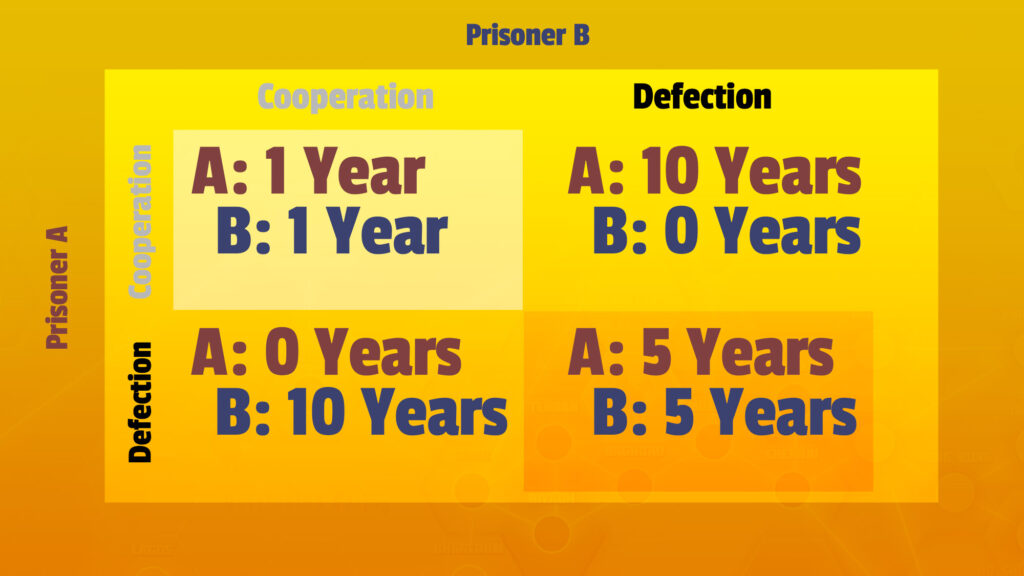
Mathematicians and business majors are exploring political science theory and philosophy through game theory. Game theory is a college level math class that is typically attended by math majors and business majors. Why business majors? Because game theory is the study of how to use logic to find the optimal strategy in a competitive situation. And the most common simulation to come out of game theory is the Prisoner’s Dilemma. Here is the scenario.
Today we will return to an idea presented earlier two weeks ago the lesson titled, “The Truth of Myth,” in which we presented the idea that nonfiction presents truth objectively, but that fiction and mythology, though objectively true, present a subjective truth that often feels even more deeply accurate than true stories. To do so we will dive deeply into the story of the popular book and film called, “Life of Pi.”