A company that I work with and sell curriculum to for after-school events, Tried & True Tutoring, paid me to run the ALLIANCE for 88 students last weekend in El Paso, Texas. They host workshops for college readiness programs that receive grants from the government to provide fun educational support for lower-socioeconomic high students.
This was the first time I have run ALLIANCE, The Ultimate World Leader Political Science Megame, for Tried & True. I’ve been working with them for a couple years, but now that I have an expansion for the game that deals with the ethical implications of A.i., they have taken it on as one of their after school offerings. But the first fish they caught was a big catch. An after school program in El Paso said they would bring out 100-110 students for the Saturday event!
100 participants is the most I have ever run the game for. But this was at Gen Con 50, and I was working with the Megagame Coalition which provided me with a good number of experienced megagamers as Control Players.
For this event in El Paso I was the only person who even knew what a megagame was. Luckily the company provided me with one professional educator which I could train for an hour during the week leading up to the event. Jimmy was great considering this was his first ever megagame. But he and I would have to facilitate the entire event without any other Control team players trained before the game!
To pull this off I prepared two solutions–14 three-player one-round of turn tutorials, and pre-written pre-adjudicated Action Reports for all 20 teams on the first two game days.
Solution 1: Tutorial
You can explain the rules to people, but until they play the game those rules don’t really make sense, unless the players can relate it to other games they have already played. So playing really is the best form of learning.
For this reason I have a small tutorial version of my game stripped of nearly all but only the most critical rules to get exactly 3 players into the core gameplay as quickly and frictionless as possible. It introduces my core game loop and helps the players understand the dynamic relationship between resource tokens, status, and negotiation.
I trained my one teacher, Jimmy, for an hour during the week leading up to the event. I printed 14 tutorials, left them out on the tables for players to use as Jimmy walked them through step-by-step how to play.
But before Jimmy lead them through the tutorial, when the students were waiting in line to be assigned a role and let into the room I asked them, “Who here has any experience with Dungeons & Dragons, tabletop RPG, board games, chess, poker, and/or dueling card games?” I found at least one dungeon master among the group, a couple board gamers, and some video gamers. I immediately took these 20 students aside and began teaching them how the game worked. I made the dungeon master my war control player, allowed a couple volunteers to be the journalists, and I chose another to be the “economist” control player whose sole responsibility was to issue out currencies each game day, and one more control player to track Status among the teams each game day. The rest of these students I appointed as a role I call the “strategist” for each team.
As the rest of the students got assigned roles on to the 20 different teams, they entered the main room where Jimmy walked them through the tutorial gameplay. These students all learned the core of the game, while I taught their “strategist” the rest of the rules at length. So there were two different trainings going on simultaneously. This worked beautifully because Jimmy hadn’t played the game before so he really wouldn’t have had the confidence to teach the rules in their entirety. But the tutorial comes with a scripted slideshow with illustrations and timers. So he literally just read from the slides and then gave them a set time to try each stage for themselves.
This whole process of getting them assigned to teams and learning how to play took up the first hour. We then had another hour before lunch and two after to play the game.
To see the tutorial simply sign up for my newsletter and it will be included in the auto response email.
Solution 2: Pre-written pre-adjudicated Action Reports
With so few experienced control players I had yet another problem. Even when I do have enough control players, it is often difficult to adjudicate all of the actions the teams want to take. This is a problem in every megagame, but especially in ALLIANCE because it is a very open-ended game, but with very measurable stats (we have 5 currencies, each with their own mechanics, and we reward achievable objectives with “status” the same way you would award victory points in a board game). Access to control players and having them adjudicate becomes the bottle-neck that keeps the players from being able to play. It also puts pressure on the control players as they rush through each adjudication.
To solve this I decided to write out two unique Action Reports for each team for them to choose between on the first game day. These are already geared towards their team’s secret objectives, and the part of the Action Report that a control player would typically fill out is already filled out as well. So this serves as a model to the players on how to fill out future Action Reports, and as a model to the new control players on how to adjudicate future Action Reports. In education we refer to this method as scaffolding. You provide more support earlier on, and reduce the support as the players learn the ropes.
This is also a great way for me to incorporate expansions into the game without overwhelming the players with new rules. The Action Reports are labeled by game day. This allows me to distribute new rules or mechanics later in the game when and to whom it is most appropriate to introduce them. It allows my best self to be there for them when I’m most needed without actually being there.
These solutions freed me up to make myself available to struggling players, while allowing more quickly advancing players to play without waiting for my adjudication. I was able to enjoy the game without feeling overwhelmed.
I also ran this expansion with the 2nd solution for a smaller group in Louisville, Kentucky back one month earlier. It helped there too, and the feedback from that group helped me to improve the bigger later game in El Paso.
So that’s how I ran a megagame for 88 participants with only one additional trained staff. The title of this article might be a little misleading since we did have some students help out with control. But even with the additional student control players that we trained on site, we only had a team of 5 control! Most megagames suggest a ratio of 1 control player for every 8 players. We had, at most, 1 for every 18 players. I’m not recommending anyone go that low, especially for a paid event. But if you have no other choice, it is possible to run a game if you do enough preparation work beforehand.
Was it a success? Well, I would say yes. Everyone involved had a great time and thought it was extremely educational while being a ton of fun.
Did the students achieve world peace? Definitely not. They were very busy going to war with each other, spending a lot of their time and resources to build weapons, and failing to negotiate. After war control reported that they were nuking each other I asked them, “Why are you not negotiating?” It turns out these students had no idea about the history of the cold war, they had never heard of defcon, and looked totally baffled by my mention of mutual destruction. Without time to explain all of this I simply told them that if they wanted to fire another nuke they would first have to get a signature on the Action Report from the nation they were targeting. I also told them to research about the Cold War in our concluding remarks. It also turns out that almost none of these students knew each other before that day. But on a lighter note, Russia did manage to create a form of sustainable energy, and another team advanced genetic modification to the point that part of their population defeated the aging process.
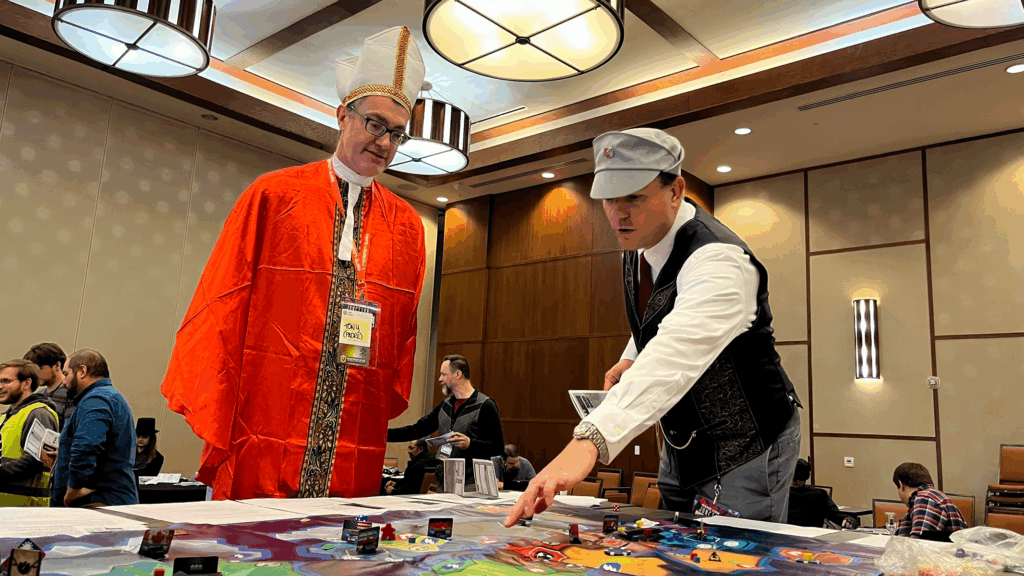
Unfortunately I never heard back from the student who agreed to take photos, but here’s a photo from the Game Con Junction megagame convention where I ran ALLIANCE in Louisville, Kentucky a month before my game in El Paso. Big thanks to Tony Dougherty, featured below, who organized the convention, designed some of the megagames played that weekend, and roleplayed as the Pope in ALLIANCE.